



























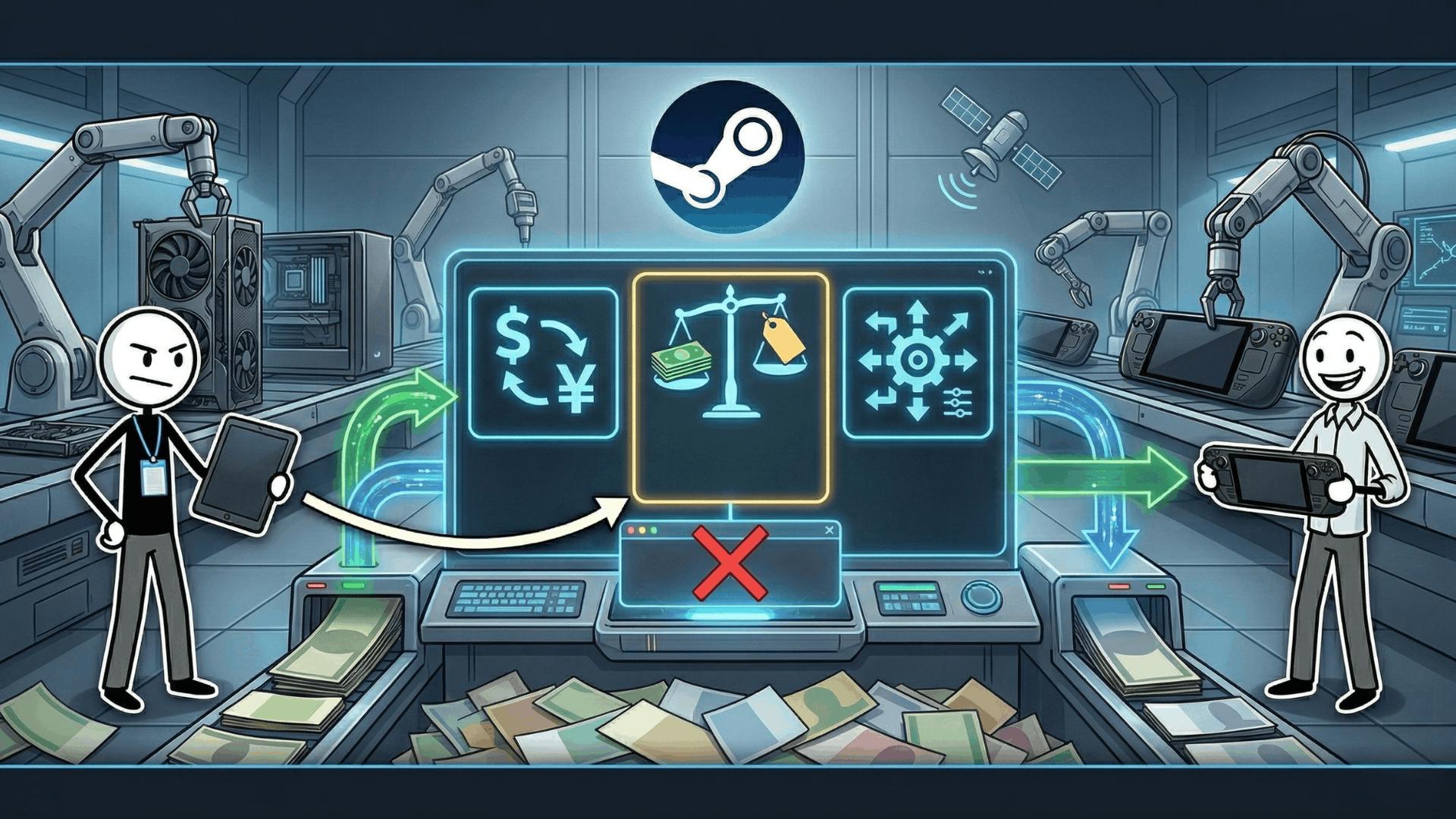
Steam's latest Steamworks update gives developers three new ways to convert USD prices into regional currencies, including a purchasing power method that accounts for local wages. It will not fix anything automatically, but it gives devs fewer excuses.
Regional pricing on Steam has been a mess for years. A game launches at $30 in the US and the same game costs the equivalent of three days' wages in Turkey, Brazil, or Southeast Asia. Players complain, sometimes loudly. Occasionally devs fix it. Most of the time, nothing changes.
Valve just made it easier to avoid that situation in the first place.
A new Steamworks update, spotted by Rock Paper Shotgun, adds better regional pricing tools for developers. There are now three conversion methods available when setting local prices, plus improved per-region pricing data to help devs understand what they are working with.
The Three New Conversion Methods
Simple exchange rate. Takes your USD price and converts it to a local currency based on the current exchange rate at the time you set it. Clean and predictable, but it does not account for the fact that $30 means something very different in Poland than it does in the US.
Purchasing power conversion. Uses public data on average purchasing power in a given country or region. According to Valve's own breakdown, this method tends to produce the lowest prices of the three, because it is actually trying to reflect what players can afford. For regions that have historically been priced out, this is the most useful option.
Multi-variable conversion. Combines purchasing power, the expected cost of comparable entertainment goods locally, and the exchange rate. It is closer to how Valve's old pricing tool worked, and it gives more mixed results depending on the region.
Steam supports 35 currencies. That is a lot of ground to cover, and most indie developers are not equipped to manually research each market. These tools lower the barrier considerably.
Why It Matters
This is not a policy change. Valve is not forcing anyone to price their game fairly. Developers still have to opt in, pick a method, and actually commit to lower prices in lower-income markets.
What the update does is remove the 'it's too complicated' excuse. If a dev ships a game at USD parity in Brazil in 2026, that is now a choice, not an oversight.
Arc Raiders ran into exactly this problem last year. Regional prices were out of step with local incomes and players pushed back. Embark ended up cutting prices in several territories after the backlash. That cycle, launch with bad prices, wait for complaints, patch it, is something this toolset could short-circuit if devs use it from day one.
What This Means for You
If you are a PC gamer in a region where Steam prices have felt unfair, this does not guarantee things improve overnight. But it is a real infrastructure change, and it signals Valve taking regional pricing more seriously as a problem worth solving.
If you use Dealshub to compare prices across stores and regions, keep an eye on Steam pricing for new releases going forward. Devs who use the purchasing power method should show noticeably lower local prices than those who just run a straight exchange rate conversion. That gap tells you something about how much a developer cares about pricing fairly.
For grey market key stores, well-priced regional Steam keys have always been part of what makes them attractive. If Steam's own regional prices get more competitive, that calculus shifts a bit.
Not a revolution. But a useful step.





Comments
Join the discussion soon
Comments are coming. Be one of the first to share your take.